Jury anonymity rule
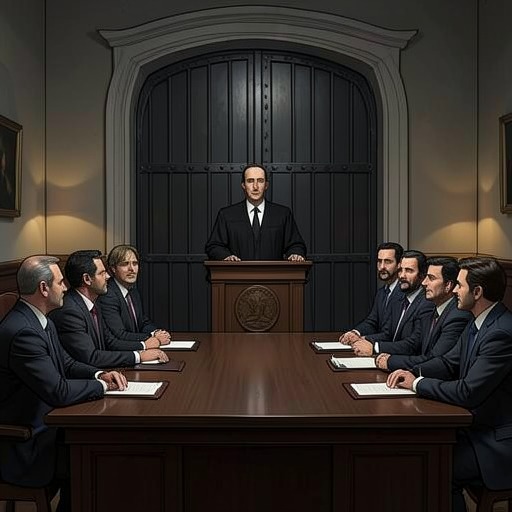
The Brass VerdictThe Jury anonymity rule is a procedural safeguard for jurors’ identities, but its significance in Walter Elliot’s case lies in the gap between protecting a jury and protecting the process that produces it. The alleged scheme did not depend on openly identifying jurors; it depended on covert access to jury selection, allowing a sleeper juror to enter the box and remain there. The case therefore exposes anonymity’s limits when the machinery behind selection is itself vulnerable to manipulation.
The Rule and Its Context
The account does not set out the rule’s formal wording or enforcement. Instead, it places the principle of juror protection against a conspiracy aimed at the jury-selection process. The danger was not simply that someone might learn who the jurors were: an unknown party was said to have access to successive random procedures that determined who would be summoned, who would form the venire for a particular trial, and which twelve people would enter the jury box.
That distinction matters. The scheme described to Michael Haller required access to the process before the jury was seated, not merely knowledge of jurors’ identities afterward. Anonymity could shield jurors from some forms of exposure without, by itself, ensuring that the selection process remained impartial.
The Sleeper and the Selection Process
Walter Elliot told Haller that Jerry Vincent had been approached after a trial date was set with an offer to place a sleeper on the jury. The arrangement depended on keeping that date unchanged: if the trial moved, the sleeper could not move with it. The account presents this condition as evidence that the unknown party’s reach extended across the random stages of selection, rather than being limited to influence over a juror already chosen.
Once seated, the sleeper was expected to avoid removal through ordinary challenges. The defense would know not to use a peremptory strike against him, while his apparent alignment with the prosecution would help him avoid a challenge from that side. The plan turned the jury’s ordinary safeguards into points of tactical pressure: a juror could appear unremarkable to one side while being covertly protected by the other. Anonymity did not itself reveal or defeat that hidden arrangement.
Confidentiality and the Duty to Intervene
Elliot’s account placed Haller in a professional conflict. Elliot had admitted crimes to him, and Haller understood those admissions to be protected by the attorney-client relationship. But Haller also concluded that the contemplated jury tampering was a future crime, not merely a completed offense disclosed in confidence. He recognized that he had a duty to report it, while also considering whether he could prevent the crime from occurring instead.
The conflict makes the rule’s stakes broader than juror privacy. A protected jury depends on more than keeping identities concealed: it also depends on the integrity of selection and on action when that integrity is threatened. Haller’s decision had to account both for his obligations to Elliot and for the danger of allowing a planned attack on the trial process to proceed.
Significance in the Trial Narrative
The scheme gives the jury a double role in the case: the jurors are the audience for competing accounts of Elliot’s guilt, and the institution meant to judge those accounts is itself a target. Haller’s opening statement urged them to reject the prosecution’s account as a maze of smoke and mirrors; Elliot’s disclosure later suggested that the jury might have been manipulated before the evidence was even heard. The contrast makes the trial’s fairness depend not only on what the jurors believe, but on whether they reached the box through an uncorrupted process.
The rule’s narrative force is therefore not a detailed account of legal doctrine. It is the tension between anonymity as a protection and selection as a potential point of attack. The sleeper plan shows how a jury can remain outwardly ordinary while the process surrounding it has been secretly compromised.